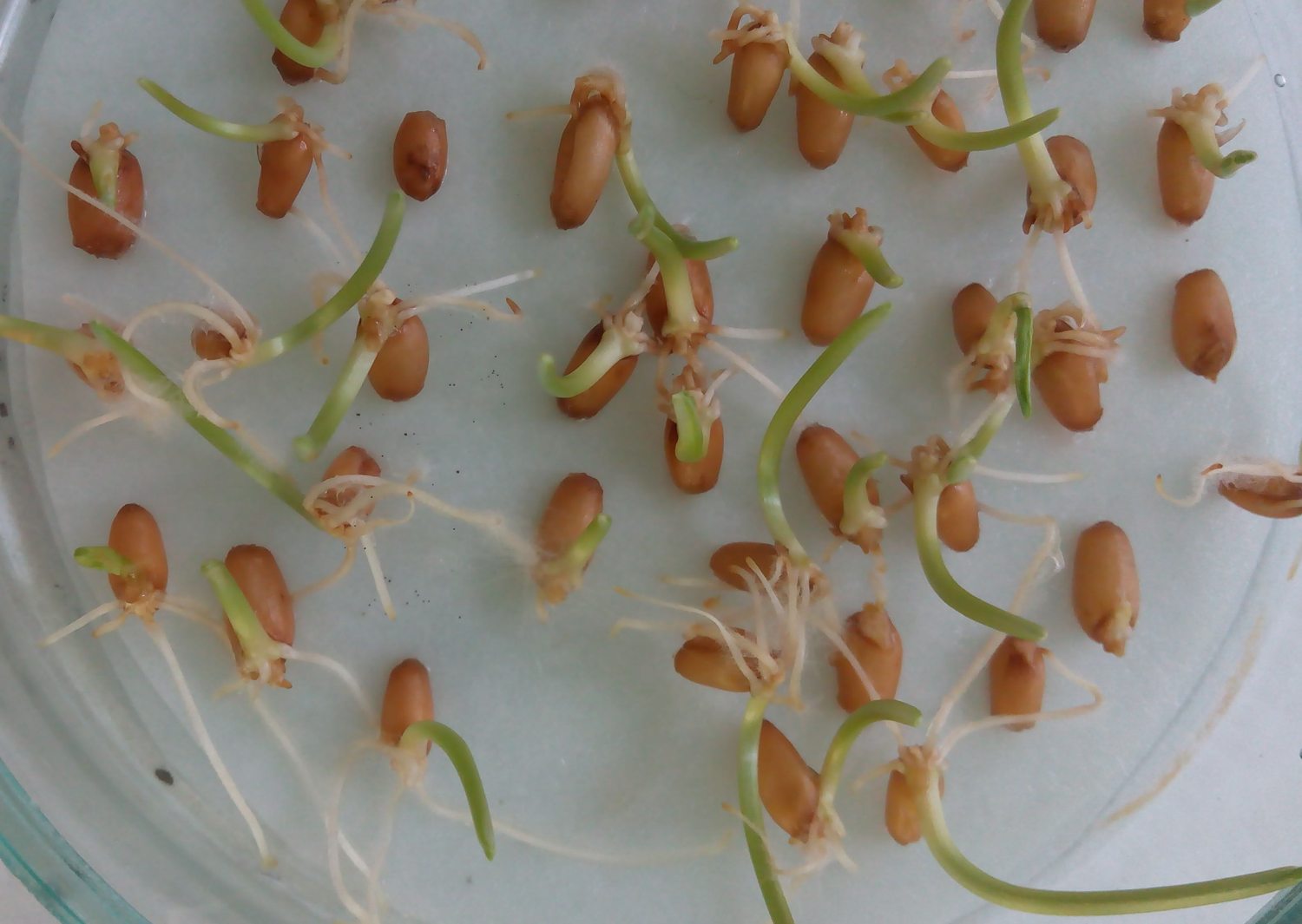
If your wheatgrass seeds are not germinating, the problem is usually one of these: low seed viability, poor storage history, too little or too much moisture, limited oxygen in waterlogged conditions, unsuitable temperature, temporary dormancy, or seed decay. In some cases, the seed has started to germinate but the shoot has not emerged above the growing medium.
Before changing your entire growing method—or assuming the seed is bad—test a small sample separately. A paper-towel germination test is the simplest way to tell whether you likely have a seed-lot problem or a tray-condition problem.
First, Test Whether the Seed Is Viable
A paper-towel test removes many of the variables involved in a wheatgrass tray, including growing medium, drainage, sowing depth, and uneven watering.
How to do a paper-towel germination test
- Count out 50 or 100 representative seeds.
Take seeds from different parts of the package or container. Do not choose only the largest, cleanest-looking grains; the sample should reflect the seed lot you actually plan to grow. [1][2]
- Moisten a clean paper towel thoroughly.
The towel should be damp throughout but not dripping or sitting in free water. Excess water can reduce oxygen around the seeds and may contribute to rot. [1][3]
- Spread the seeds across the towel.
Fold or roll the towel so the seeds remain moist and can be inspected without being crowded too tightly.
- Keep the test near 70°F.
University of Alaska Fairbanks lists about 70°F and a seven-day test period for wheat. This is a useful home-testing condition, not the only temperature at which wheat can germinate. [1]
- Check the seeds through seven days.
Look first for swelling and small roots, which show that germination has begun. For an approximate germination result, count seedlings that have developed normally with both adequate root and shoot growth—not merely a tiny root tip. [1][2]
- Calculate an approximate result.
\[ \text{Approximate germination percentage} = \frac{\text{healthy seedlings}}{\text{total seeds tested}} \times 100 \]
For example, if 42 of 50 seeds develop into normal seedlings, the estimated germination percentage for that sample is 84%.
A home test is useful for troubleshooting, but it is not a certified commercial seed analysis.
What the results usually mean
| Paper-towel test result | What it may suggest |
|---|---|
| Most seeds develop normally in the towel but fail in the tray | The seed is probably not the main issue; investigate tray moisture, drainage, temperature, growing medium, or handling. |
| Few or no seeds develop normally in either test | Seed age, storage conditions, damage, temporary dormancy, or low seed-lot viability may be involved. |
| Seeds germinate slowly or unevenly | Variable seed vigor, inconsistent moisture, temperature, or dormancy may be contributing. |
| Seeds swell but become soft, brown, or unpleasant-smelling | Excess moisture and possible decay are more likely than simple slow germination. |
| Roots appear but no shoots emerge in the tray | Germination may have occurred, but emergence conditions may be unfavorable. |
One failed tray does not prove that a supplier sold defective seed. Compare the tray with a representative controlled test before drawing conclusions.
The Most Common Reasons Wheatgrass Seeds Do Not Germinate
The seed is old, damaged, or poorly stored
Seed viability is the ability to germinate. Seed vigor describes how quickly and uniformly a viable seed can germinate and establish under less-than-ideal conditions. Both can decline as seed ages or experiences unfavorable storage conditions. [4]
Heat, moisture exposure, repeated temperature swings, mechanical damage, and unknown storage history can all contribute to weaker performance. Older seed may still sprout, but it may do so more slowly or unevenly.
There is no universal expiration date for wheatgrass seed. Seed longevity depends on the original seed quality and its storage conditions. A paper-towel test is more useful than age alone when deciding whether a particular lot is still worth growing.
Cracked, crushed, or severely damaged grains may be less likely to perform well, but appearance alone cannot reliably tell you whether an individual seed is viable. [4]
The seeds are too dry
Seeds need to absorb water before germination can begin. If the towel or growing medium never becomes thoroughly moist, germination may be delayed, sparse, or uneven. [3]
Check moisture across the entire tray rather than relying on a watering schedule or room humidity. One area may be drying out while another remains too wet. Inconsistent moisture can produce patchy germination that looks like a seed-quality problem.
Research on wheat shows that reduced water availability can slow germination and lower the proportion of seeds that germinate, although the response varies by wheat variety and temperature. [5][6]
That does not mean a brief dry period makes every seed unusable. It means persistently inadequate moisture is an important troubleshooting factor.
The seeds are too wet and lack oxygen
Too much water can be as problematic as too little. Germinating seeds need moisture, but they also need oxygen. When seeds sit in standing water or saturated media, the air spaces around them can fill with water, limiting oxygen availability. [3]
Look for these conditions:
- standing water in or beneath the tray
- a growing medium that remains saturated for long periods
- seeds sitting in puddles after soaking or watering
- poor drainage
- swollen seeds that become soft rather than producing healthy roots
- sour or unpleasant odors
The practical target is moist but not submerged, dripping, or persistently waterlogged. [1][3]
A covered tray or moisture-retaining container is not automatically a problem; home germination-test methods commonly use them to prevent drying. The concern is not enclosure by itself, but conditions that remain excessively wet or leave little air space around the seeds. [1][2]
The temperature is too cold or too hot
Temperature affects the speed of germination. Wheat generally performs better under moderate conditions than at temperature extremes. Oklahoma State University identifies approximately 54–77°F as an optimal wheat-germination range, while noting that responses to heat can differ among varieties. [7]
Cooler conditions may slow germination. Excessive heat can also delay germination in some wheat varieties. [7]
For troubleshooting, pay attention to the temperature around the seeds—not just the room thermostat. A tray on a cold floor, near a drafty window, or above a heat source may be experiencing a much different temperature than the rest of the room.
The 54–77°F range comes from wheat research and should be used as a troubleshooting guide, not as a mandatory indoor wheatgrass rule.
The seed may be temporarily dormant
Recently harvested wheat can sometimes be viable but temporarily unable to germinate. This is called post-harvest dormancy, and it may end after an after-ripening period. [7][8]
Dormancy is a possible explanation, especially for recently harvested wheat, but it should not be the default assumption for every failed wheatgrass tray. Moisture, oxygen, temperature, storage, and seed quality are more practical factors to test first.
Allow the full seven-day test period before deciding that slow seeds are dead.
Soaking or draining may have created a moisture imbalance
Soaking can help wheat seeds take up water, but soaking and draining also affect the moisture–oxygen balance. Seeds that remain saturated after soaking, are poorly drained, or are placed into an already waterlogged medium may have difficulty progressing normally.
Rather than relying on one fixed soaking time for every seed lot and setup, use the paper-towel test and a small tray comparison to evaluate your own conditions. Wheat variety, seed condition, temperature, container design, and growing medium can all affect the result.
If seeds perform well in a controlled towel test but fail after soaking and planting, focus on how thoroughly they drain and how wet the tray remains afterward.
Seeds may be decaying before seedlings emerge
Slow germination combined with cool or persistently wet conditions can increase the opportunity for seed decay and damping-off-type problems. Field-wheat and general seedling research identify seed decay, root rot, and damping off as possible causes of poor emergence under unfavorable conditions. [9][10]
A home wheatgrass tray is not the same as a field-wheat system, so these sources explain possible mechanisms rather than diagnosing a specific problem in your tray.
Softness, browning, collapse, or an unpleasant odor are warning signs of possible decay. They do not identify a specific fungus or pathogen. Likewise, white material near a seed cannot be reliably identified as harmless root hairs or mold from a brief description alone.
If a batch is visibly deteriorating:
- discard questionable seed or growing material
- empty and clean the tray before reusing it
- use clean water and clean handling practices
- avoid keeping replacement media persistently saturated
- compare the next tray with a separate paper-towel test
Household chemical treatments should not be treated as guaranteed ways to restore poor germination or make questionable seeds safe for food use. [11][13]
Did the Seeds Germinate but Fail to Emerge?
No green shoots does not always mean the seeds never germinated. Germination begins when the seed starts developing, while emergence is the later appearance of the shoot above the growing medium. [4]
Look for roots before green shoots
If you can inspect the tray gently, look for:
- swollen seeds
- partially opened seed coats
- small white roots
- roots beneath the growing-medium surface
- seeds that have collapsed or softened
Roots indicate that germination has at least started. If roots are present but green shoots are not, focus on emergence conditions rather than assuming the seeds were nonviable.
Test the tray conditions
When seeds germinate in a towel but not in the tray, use a small side-by-side test to investigate potential differences in:
- moisture and drainage
- temperature
- seed coverage
- the physical condition of the growing medium
- signs of seed decay
For example, a heavily covered or dense growing medium may be worth testing as an emergence hypothesis, but it should not be assumed to be the cause without comparison. Change one major variable at a time where practical.
Reset a small test area
Instead of repeating a full failed tray, test a smaller section with the same seed lot. Compare it with the paper-towel test and alter only one main condition, such as drainage, moisture level, tray location, or growing medium.
This approach wastes less seed and gives you clearer information about what changed the result.
Troubleshooting Wheatgrass Germination by Symptom
| What you see | More likely explanation | First thing to test |
|---|---|---|
| No roots in the tray or paper-towel test | Low viability, poor storage history, dormancy, or unsuitable temperature | Repeat a representative test near 70°F and observe through seven days. |
| Roots in the towel but not in the tray | Tray moisture, oxygen, drainage, temperature, or emergence conditions | Check for standing water, uneven moisture, and differences between the tray and towel test. |
| Seeds are swollen but soft or sour-smelling | Possible excess moisture and decay | Discard the questionable batch, clean the setup, and restart with a controlled test. |
| Germination is sparse and uneven | Variable vigor, uneven moisture, temperature differences, or uneven seed distribution | Test the seed lot and inspect conditions across different tray areas. |
| Seeds sprout only after several days | Temperature, water stress, variable vigor, or possible dormancy | Allow the full test period and measure the conditions around the seeds. |
| Roots are visible but green shoots are absent | Emergence issue rather than complete failure to germinate | Test differences in moisture, medium condition, coverage, and temperature. |
| One part of the tray sprouts while another does not | Uneven moisture, drainage, temperature, or seed distribution | Compare successful and unsuccessful sections of the same tray. |
These are troubleshooting clues, not definitive diagnoses. More than one cause can produce similar symptoms.
When Should You Replace the Seed?
Consider replacing or setting aside the seed when:
- a representative paper-towel test remains poor after seven days
- the seeds have an unknown or clearly unfavorable storage history
- a large portion of the sample is soft, collapsed, or decaying
- the seed repeatedly performs poorly in controlled tests
- the label states “Do not use for food” or “Do not use for feed” and you intend to grow wheatgrass for juice or food [11]
If the paper-towel test performs well but trays repeatedly fail, the seed may not be the main issue. Investigate tray moisture, drainage, temperature, handling, and growing-medium conditions before discarding a viable lot.
Before blaming the supplier
Poor germination does not by itself prove that a specific retailer or supplier is responsible. Before assigning blame:
- Test a representative sample.
- Review the seed’s storage history.
- Check the intended-use labeling.
- Compare tray performance with a controlled towel test.
- Record temperature and moisture conditions.
- Repeat the test if the first result is unclear.
Is It Safe to Use Planting Seed for Wheatgrass Juice?
Check the product label and intended use before growing wheatgrass for juice or food.
Do not use seed labeled “Do not use for food” or “Do not use for feed” for an edible crop. Under 7 CFR § 201.31a, certain treated seed with potentially harmful residual substances must carry cautionary labeling. [11]
This does not mean that every seed sold for planting is treated. It does mean that a food-use warning should be taken seriously. Rinsing or soaking seed does not establish that it is suitable for food use.
Raw or unpasteurized vegetable juices can carry food-safety risks if harmful microorganisms are present on the raw ingredients. Wheatgrass is not specifically addressed in FDA’s general juice-safety consumer guidance, but the broader principle supports careful handling of raw plant material and juice. [12][13] Clean handling and avoiding deteriorating, waterlogged material are sensible precautions, but they cannot guarantee elimination of microbial hazards.
Frequently Asked Questions
Research & Further Reading
University, extension, scientific, and regulatory sources
[1] University of Alaska Fairbanks Cooperative Extension Service, Procedures for the Wet Paper Towel Germination Test https://www.uaf.edu/ces/publications/database/gardening/procedures-wet-towel-germ.php
[2] Kansas State University, At Home Germination Testing for Wheat Seed https://www.sunflower.k-state.edu/agronomy/docs/At%20Home%20Germination%20Testing%20for%20Wheat%20Seed.pdf
[3] University of Georgia Cooperative Extension, Starting Plants From Seed for the Home Gardener https://fieldreport.caes.uga.edu/publications/B1432/starting-plants-from-seed-for-the-home-gardener/
[4] NC State Extension, Seed and Seed Quality https://content.ces.ncsu.edu/seed-and-seed-quality
[5] Mirdad, Z. et al., The Effect of Temperature and Water Stresses on Seed Germination and Seedling Growth of Wheat (Triticum aestivum L.) https://www.mdpi.com/2071-1050/14/7/3887
[6] Validating the Impact of Water Potential and Temperature on Seed Germination of Wheat (Triticum aestivum L.) via Hydrothermal Time Model https://pmc.ncbi.nlm.nih.gov/articles/PMC9315726/
[7] Oklahoma State University Extension, Factors Affecting Wheat Germination and Emergence in Hot Soils https://extension.okstate.edu/fact-sheets/print-publications/pss/factors-affecting-wheat-germination-and-emergence-in-hot-soils-pss-2256-a.pdf
[8] Virginia Cooperative Extension, Understanding Pre-harvest Sprouting of Wheat https://ext.vt.edu/content/pubs_ext_vt_edu/en/424/424-060/424-060.html
[9] Montana State University Extension, Montana Wheat Production Guide https://www.montana.edu/extension/Full_HTML_Pubs/EB0197-MontanaWheatProductionGuide/EB0197_MontanaWheatProductionGuide.html
[10] University of Minnesota Extension, How to Prevent Seedling Damping Off https://extension.umn.edu/garden-and-home/yard-and-garden/gardening-in-minnesota/yard-and-garden-problems/how-to-prevent-seedling-damping-off
[11] Electronic Code of Federal Regulations, 7 CFR § 201.31a—Labeling Requirements for Treated Seed https://www.ecfr.gov/current/title-7/subtitle-B/chapter-II/part-201/subpart-C/section-201.31a
[12] U.S. Food and Drug Administration, What You Need to Know About Juice Safety https://www.fda.gov/food/buy-store-serve-safe-food/what-you-need-know-about-juice-safety
[13] U.S. Food and Drug Administration, Guidance for Industry: Reducing Microbial Food Safety Hazards in the Production of Seed for Sprouting https://www.fda.gov/regulatory-information/search-fda-guidance-documents/guidance-industry-reducing-microbial-food-safety-hazards-production-seed-sprouting
Company and product information—not scientific evidence
Andi’s Way, Organic Wheatgrass Seeds—Hard Red Winter Wheat https://andisway.com/products/hard-red-winter-wheat-seed
Andi’s Way, Growing Trays With Drain Holes https://andisway.com/products/growing-trays-with-drain-holes
Related guides
How to Bottom-Water Microgreens Without Waterlogging the Tray
Learn how to bottom-water microgreens with nested trays, moisture checks, drain-off steps, and practical tips to avoid soggy media and standing water.
12 min read
Best Growing Medium for Microgreens: Soil vs Coco Coir vs Grow Mats
Compare potting mix, coco coir, and grow mats for microgreens. Learn the trade-offs in watering, cleanup, crop support, reuse, tray setup, and food safety.
16 min read
Do Microgreens Regrow After Cutting?
Most microgreens are a one-time harvest. Learn why some shoots may regrow after cutting, how baby greens differ, and when reseeding is the better choice.
8 min read
Stay in the loop
New guides, when they publish
An occasional email when a new guide goes live. No spam.
Your email is stored privately for future guide updates. No emails are being sent yet. Privacy policy