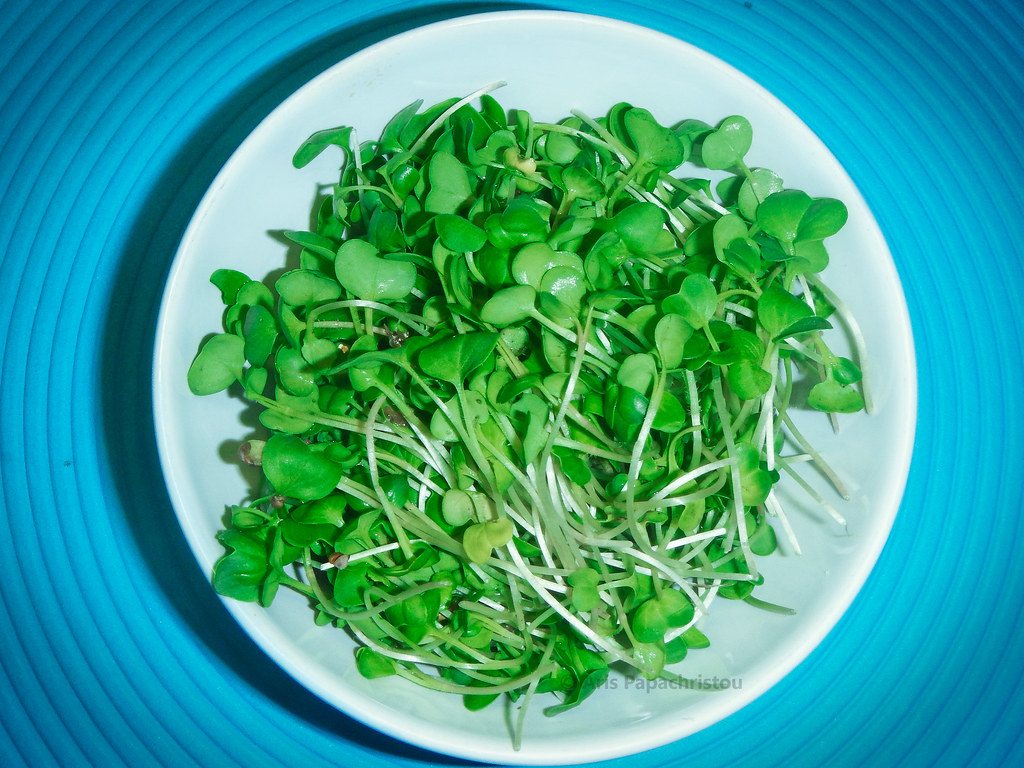
Radish microgreens taste spicy because they contain glucosinolates and the enzyme myrosinase. When you chew, chop, slice, or blend the greens, their cells are disrupted, allowing myrosinase to interact with glucosinolates and help form pungent compounds called isothiocyanates. These compounds create radish’s peppery, mustard-like, or horseradish-like bite—not the capsaicin-based heat of chili peppers. 1 2
The Short Version: A Natural Mustard-Family Flavor System
Radish belongs to the Brassicaceae, or mustard, family. Many plants in this family have sharp, peppery, bitter, or sulfurous flavor notes.
“Spicy” is a useful everyday description, but pungent is more precise. Pungency describes a sharp or irritating sensation that may feel peppery, mustard-like, or tingly around the mouth and nose.
Radish microgreen flavor can include several qualities at once:
| Flavor term | What it describes |
|---|---|
| Peppery or pungent | A sharp, mustard-like bite or nose-tingle |
| Bitter | A distinct taste that may occur alongside pungency |
| Sulfurous | An aroma associated with some Brassicaceae compounds |
| Fresh or green | Plant-like aroma and flavor notes |
Peppery and bitter are not interchangeable. A serving may be strongly peppery without tasting very bitter, or it may have both qualities. The balance depends on the plant’s compounds, preparation, cultivar, and the person eating it. 3
What Happens When You Bite or Chop Radish Microgreens?
Radish microgreens have a plant-defense system that becomes noticeable when their tissues are damaged during eating or preparation.
Intact microgreen → chewing or chopping breaks cells → enzyme meets precursor compounds → pungent compounds become more noticeable
Glucosinolates: The Precursor Compounds
Glucosinolates are sulfur-containing plant compounds found in many Brassicaceae vegetables. In intact plant tissue, glucosinolates and myrosinase are largely separated from one another.
They act as starting materials for several compounds associated with the characteristic flavors of radish, mustard, and related vegetables.
Myrosinase: The Enzyme That Meets Them After Tissue Disruption
Myrosinase is an enzyme naturally present in the plant. When you bite, chop, slice, crush, or blend radish microgreens, plant cells are broken and the enzyme can come into contact with glucosinolates.
This contact allows the breakdown reaction to occur. It does not mean that chopping will make every serving predictably hotter, but it creates the conditions under which pungent compounds can form and become more noticeable. 1 2
Isothiocyanates: Compounds That Contribute to the Bite
The glucosinolate–myrosinase reaction can produce isothiocyanates. These compounds are major contributors to the sharp, peppery, mustard-like pungency associated with radish and other Brassicaceae vegetables.
Isothiocyanates are not the only substances involved in flavor. Other volatile compounds, bitterness, fresh green notes, the particular cultivar, and the food being eaten alongside the microgreens can all affect the final experience. 3
A Radish-Specific Detail: Why the Flavor Can Seem So Sharp
Radish research has identified several radish-associated isothiocyanates. One is 4-methylthio-3-butenyl isothiocyanate, sometimes called raphasatin.
You do not need to remember the name to understand the basic point: radish has a distinctive group of pungent compounds that helps give it a sharper, more mustard-like or horseradish-like character.
In one analysis of four radish microgreen cultivars, researchers identified 51 volatile compounds, including 13 isothiocyanates. The study used instrumental chemical analysis rather than a broad consumer taste survey, but the results showed that the volatile profiles differed among the cultivars. 4
Why One Radish Microgreen Batch May Taste Sharper Than Another
Cultivar Can Change the Flavor Profile
Different radish cultivars can have different glucosinolate and volatile-compound profiles. In practical terms, one seed type may taste more peppery, sulfurous, fresh, or assertive than another.
Cultivar is an evidence-backed reason for flavor variation, but it does not provide a guaranteed heat scale. Research has not established a universal ranking of all commonly sold radish microgreen varieties from mildest to hottest. 4 5
Flavor Is More Than One Chemical Measurement
It may be tempting to assume that more glucosinolates always means hotter-tasting microgreens. The relationship is more complicated.
A serving’s perceived pungency can reflect:
- The specific glucosinolates present
- Which breakdown products form after cutting or chewing
- The activity of myrosinase
- Other volatile aroma compounds
- Bitter, sulfurous, fresh, or green notes
- The amount eaten
- The other ingredients in the dish
- Individual sensory perception
For that reason, one chemical measurement does not fully predict how spicy a serving will taste. The same type of microgreen may seem pleasantly peppery to one person and too sharp to another. 3
What Research Cannot Yet Tell Shoppers
Research shows that radish microgreen cultivars can differ chemically. However, instrumental volatile analysis is not the same as a controlled consumer taste ranking.
Similarly, experimental growing treatments can change measured plant compounds in research settings. That does not establish a simple home-growing method that reliably makes radish microgreens hotter or milder. Claims about using a particular light, watering schedule, growing medium, or plant stress technique should therefore be treated cautiously. 4 5 6
Is Radish Microgreen Heat the Same as Chili Heat?
No. Both can feel sharp or hot, but they involve different plant compounds and often create different sensory experiences. 3
| Radish microgreens | Chili peppers |
|---|---|
| Pungency is primarily associated with isothiocyanates | Heat is associated with capsaicinoids, including capsaicin |
| Often described as peppery, mustard-like, or horseradish-like | Often described as warming or burning |
| May include sulfurous or fresh green aroma notes | Have their own characteristic pepper aromas |
| Often provides a crisp, sharp finishing note | Heat may become more persistent depending on the chili, amount, and dish |
How to Use Spicy Radish Microgreens Without Overpowering a Dish
Radish microgreens are often easiest to enjoy as an accent rather than as a large base green. Their sharpness can add contrast to mild, rich, creamy, or starchy foods.
Use Them as an Accent Rather Than a Base Green
Start with a small handful or pinch. Scatter the microgreens over a finished dish, taste, and add more if you want a stronger bite.
This approach is especially useful when trying a new radish seed type or serving the microgreens to people with different spice preferences.
Pair Their Peppery Bite With Mild or Rich Foods
Try radish microgreens with:
- Avocado toast
- Fried, scrambled, or poached eggs
- Omelets and breakfast sandwiches
- Cucumber salads
- Soft cheeses
- Yogurt-based sauces
- Rice and grain bowls
- Tacos
- Roasted vegetables
- Sandwiches and wraps
These pairings provide contrast without requiring the radish flavor to carry the entire dish. Creamy, starchy, or mild ingredients can make the overall combination feel more balanced.
Add Them Near the End for a Fresh Finish
Try adding radish microgreens just before serving. As a garnish or finishing green, they can provide crisp texture and a bright peppery note.
For sandwiches, tuck them in with the other toppings. For tacos or grain bowls, scatter them over the top rather than mixing a large amount throughout the dish.
If the Flavor Is Too Strong
If radish microgreens taste too intense, try:
- Using a smaller amount
- Mixing them with milder greens
- Adding them to eggs, avocado, cheese, rice, or a creamy sauce
- Trying a different radish cultivar or seed type
These are serving adjustments, not guaranteed methods for changing the plant’s chemistry.
Does a Stronger Bite Mean Better, Fresher, or Healthier Microgreens?
No. A stronger bite is a flavor characteristic. By itself, it does not establish that the microgreens are fresher, more nutritious, or better for health. The flavor evidence discussed here describes sensory compounds and perception, not a ranking of nutritional or health value. 3
Perceived pungency can reflect multiple plant compounds, how the tissue was prepared, the food context, and individual sensory perception. It should not be used as a scorecard for freshness or nutritional quality.
FAQ
Research & Further Reading
Scientific sources
**[1] Small Variation of Glucosinolate Composition in Japanese Cultivars of Radish (Raphanus sativus L.) Requires Simple Quantitative Analysis for Breeding of Glucosinolate Component** Radish glucosinolate research discussing radish-associated pungent compounds, including 4-methylthio-3-butenyl isothiocyanate. https://pmc.ncbi.nlm.nih.gov/articles/PMC3405960/
[2] Tipping the Scales—Specifier Proteins in Glucosinolate Hydrolysis Review of glucosinolate breakdown and the role of myrosinase after plant tissue is disrupted. https://pubmed.ncbi.nlm.nih.gov/18085474/
[3] Taste and Flavor Perceptions of Glucosinolates, Isothiocyanates, and Related Compounds Review of the sensory roles of glucosinolates, isothiocyanates, bitterness, aroma, and pungency. https://pubmed.ncbi.nlm.nih.gov/29578640/
[4] Comparative Analysis of Volatile Compounds from Four Radish Microgreen Cultivars Based on Ultrasonic Cell Disruption and HS-SPME/GC–MS Direct instrumental analysis of volatile compounds in four radish microgreen cultivars, including cultivar-related differences and identified isothiocyanates. https://pubmed.ncbi.nlm.nih.gov/37834435/ https://www.mdpi.com/1422-0067/24/19/14988
[5] Radish Microgreens Produced Without Substrate in a Vertical Multi-Layered Growing Unit Are Rich in Nutritional Metabolites Research documenting differences in radish microgreen metabolite profiles among cultivars. https://pmc.ncbi.nlm.nih.gov/articles/PMC10536316/
[6] Preharvest Methyl Jasmonate Treatment Affects the Mineral Profile, Metabolites, and Antioxidant Capacity of Radish Microgreens Produced Without Substrate Controlled research showing that experimental treatments can affect measured plant compounds; it does not establish a dependable home method for controlling perceived spiciness. https://pmc.ncbi.nlm.nih.gov/articles/PMC10930673/
Company/product information—not scientific evidence
Andi’s Way Organic Radish Microgreen Seed product page Company information for readers interested in growing radish microgreens at home. The product page’s flavor description is not evidence for the chemistry or health effects of radish microgreens. Revalidate the page before publication. https://andisway.com/products/radish-microgreen-seed
Related guides
Radish Sprouts vs. Radish Microgreens: What’s the Difference?
Compare radish sprouts and radish microgreens by growth stage, harvest method, flavor, nutrition, and food safety.
13 min read
What Are Radish Microgreens?
Radish microgreens are young radish seedlings with a crisp, peppery flavor. Learn how they differ from sprouts, how to use them, and the basics of growing them.
10 min read
Sunflower Sprouts vs. Sunflower Microgreens: What’s the Difference?
Learn how sunflower sprouts and sunflower microgreens differ in growth stage, harvest method, texture, uses, and raw-food safety considerations.
13 min read
Stay in the loop
New guides, when they publish
An occasional email when a new guide goes live. No spam.
Your email is stored privately for future guide updates. No emails are being sent yet. Privacy policy