Microgreens · Radish Microgreens
Radish Sprouts vs. Radish Microgreens: What’s the Difference?
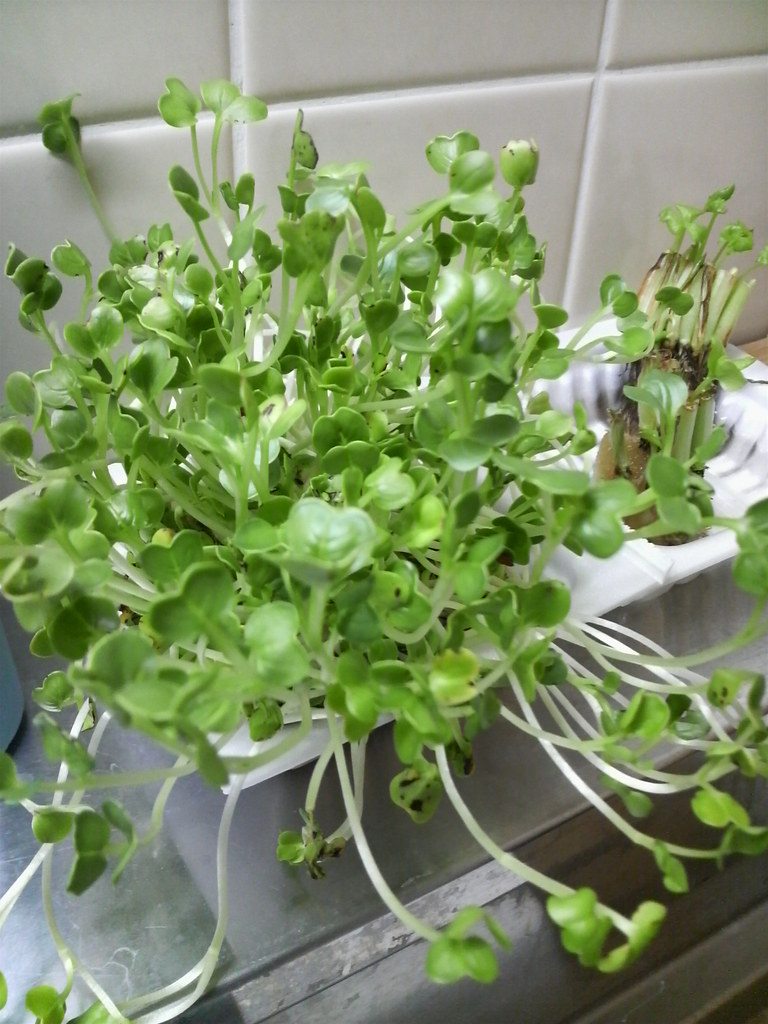
Radish sprouts and radish microgreens come from the same crop but are harvested at different growth stages. Radish sprouts are very young germinated seeds, usually eaten whole with the stem, root, and seed remnants attached. Radish microgreens are grown for several additional days, then typically cut above the growing medium and eaten as leafy stems.
The distinction is not simply whether the plants were grown in water or soil. Growth stage and harvest method are more useful ways to tell them apart. Raw radish sprouts also require particular food-safety caution because bacteria can be present on or in sprouting seeds and multiply during sprouting. In one controlled study using experimentally contaminated radish seeds, radish microgreens had lower E. coli levels at harvest than radish sprouts—but microgreens were not risk-free.
Radish Sprouts vs. Radish Microgreens at a Glance
| Feature | Radish Sprouts | Radish Microgreens |
|---|---|---|
| Growth stage | Early germination stage, usually before true leaves emerge | Later young-seedling stage, with developed cotyledons and possibly emerging true leaves |
| Typical timing | Commonly harvested within several days | Often harvested after about a week or more, depending on conditions |
| Harvest form | Usually harvested and eaten whole | Usually cut above the growing medium |
| Edible portion | Root, stem, cotyledons, and often seed remnants | Stems, cotyledons, and leaves; roots typically remain in the growing medium |
| Common growing setup | Often grown in a water-based sprouting system | Commonly grown in trays with soil, substrate, or certain soil-free systems |
| Flavor | Can have a radish-like bite; heat varies | Can also taste radish-like; flavor varies with cultivar, age, and growing conditions |
| Typical uses | Sandwiches, salads, wraps, and other whole-sprout uses | Salads, sandwiches, bowls, garnishes, and other leafy applications |
| Food-safety context | Raw sprouts have a heightened food-safety risk profile and receive specific FDA caution | Still raw produce and not risk-free; one controlled study found lower pathogen levels than in sprouts |
What Is a Radish Sprout?
Harvest Stage and Edible Parts
A radish sprout is harvested during the early germination stage. The seed has absorbed water and begun growing, but the plant is generally harvested before true leaves develop.
Radish sprouts are usually eaten whole. Depending on how they were grown and harvested, the serving may include:
- The young root
- The stem
- The cotyledons, or first seed leaves
- Part of the seed coat or other seed remnants
This whole-plant format is one of the clearest practical differences between sprouts and microgreens. Sprouts are not generally cut at the base and separated from their roots before serving. The FDA’s sprout guidance and Iowa State University Extension’s microgreen guide describe this broader distinction between whole sprouts and cut microgreens.
How Radish Sprouts Are Commonly Grown
Sprouts are often produced in water-based systems such as jars, trays, or other containers designed for moisture, rinsing, and drainage. The seed is kept moist while it germinates and develops.
A clean-looking sprouting setup does not eliminate food-safety concerns. Bacteria can be present on or inside seeds before sprouting begins. The warm, moist conditions that support germination can also allow certain bacteria to multiply. FDA guidance explains why contaminated seed is an important concern in sprout production.
The choice of seed also matters. FDA recommends using seed produced and handled for sprouting. Seed labeled for microgreen production should not automatically be assumed to be suitable for raw sprouting; verify the intended use and follow the supplier’s guidance. The FDA’s guidance on seed for sprouting provides additional context.
Typical Taste and Uses
Radish sprouts can provide a compact, crisp ingredient with a radish-like flavor. The level of heat or pepperiness depends on the radish cultivar, age at harvest, and growing conditions.
Their whole-sprout form can work well in:
- Sandwiches and wraps
- Salads
- Grain bowls
- Cold appetizers
- Dishes where a crisp sprout texture is useful
It is not accurate to say that every radish sprout is hotter than every radish microgreen. Flavor can vary considerably between varieties and growing conditions.
What Is a Radish Microgreen?
Harvest Stage and Edible Parts
Radish microgreens are allowed to grow beyond the earliest sprout stage. They are usually harvested once the cotyledons have developed and, depending on the variety and timing, the first true leaves may be emerging.
Instead of serving the entire plant, growers generally cut radish microgreens above the growing medium. The harvested portion consists primarily of:
- Stems
- Cotyledons
- Emerging true leaves, when present
The roots are typically left behind because standard microgreen harvesting focuses on the portion above the growing medium. Root removal changes the harvested format, but it does not by itself guarantee that the greens are free of pathogens.
Why a Microgreen Is Not Defined by Soil Alone
Soil or another growing substrate is common for microgreens, but soil is not the sole definition.
Radish microgreens can also be grown using soil-free or substrate-free systems. For example, a 2023 study examined radish microgreens produced without a conventional substrate in a water-based, vertical growing system. The crop was still treated as a microgreen because it was grown to a later leafy stage and harvested in that form. See Tilahun et al.’s radish microgreen study.
The more useful distinctions are:
- Growth stage: Sprouts are harvested earlier; microgreens are grown longer.
- Harvest form: Sprouts are generally eaten whole; microgreens are usually cut as leafy greens.
- Growing medium: Water, soil, or another medium may be typical, but it is not an absolute test.
Growing a seed in water does not automatically make the resulting plant a sprout if it is allowed to develop and is harvested as a microgreen.
Typical Taste and Uses
Radish microgreens can add a fresh, radish-like flavor to foods. Their intensity varies with the cultivar, growing conditions, and harvest age, so they should not be described as universally mild or universally hot.
Because they are harvested as leafy stems, radish microgreens are often used in:
- Salads
- Sandwiches
- Grain and vegetable bowls
- Garnishes
- Open-faced sandwiches
- Plated dishes
Their leafy format can make them easier to distribute across a dish than whole sprouts, but the better choice depends on the texture and appearance a recipe needs.
Which Takes Longer to Grow?
Radish sprouts are generally ready sooner because they are harvested shortly after germination. Radish microgreens receive several additional days of growth so they can develop a more substantial stem and leaf structure.
As a practical guide:
- Radish sprouts: commonly harvested within several days
- Radish microgreens: often harvested after about a week or more
These are not fixed schedules. Timing can change with:
- Radish cultivar
- Temperature
- Light exposure
- Planting density
- Moisture management
- Desired harvest size
- Whether the grower wants developed cotyledons or emerging true leaves
In one controlled radish food-safety experiment, sprouts were harvested at five days and microgreens at seven days. A separate radish microgreen study analyzed plants after 10 days. University Extension guidance also emphasizes harvesting microgreens according to plant development rather than relying on one universal calendar date.
Are Radish Sprouts or Microgreens More Nutritious?
Neither is universally more nutritious.
The measured nutrient profile depends on the radish cultivar, growing conditions, harvest stage, nutrient being measured, and laboratory method. A comparison of one variety or growing system should not automatically be applied to every radish sprout or microgreen.
A 2025 study of four red-radish cultivars found different compositional patterns at different stages. In the tested cultivars and conditions, sprouts had higher measured protein, while microgreens had higher measured amounts of organic acids, ash, and soluble dietary fiber. The study demonstrates that nutritional differences can exist between stages, but it does not establish a universal nutritional winner. See the 2025 Agronomy study.
Research has also measured vitamins, minerals, phenolic compounds, glucosinolates, and other phytochemicals in radish microgreens. These findings describe composition. They do not prove that eating radish microgreens prevents disease, treats inflammation, detoxifies the body, or produces a particular health outcome.
Reported nutrient values should also be compared cautiously. Different studies may use different:
- Radish cultivars
- Seed densities
- Growing media
- Light conditions
- Harvest ages
- Laboratory methods
There is limited human clinical evidence comparing health outcomes from eating radish sprouts with those from eating radish microgreens. The available research mainly addresses composition and food-safety behavior, not whether one stage produces better long-term health results. The review of microgreen nutrition and food safety by Turner, Luo, and Buchanan provides broader context for the limits of this evidence.
Food Safety: Are Radish Microgreens Safer Than Radish Sprouts?
The short answer is that radish microgreens may have a lower relative pathogen burden under some conditions, but they are not automatically safe or risk-free.
Why Raw Sprouts Receive Special FDA Attention
Bacteria can be present on or inside seeds used for sprouting. During germination, warm and moist conditions can support bacterial growth, even when surrounding equipment and the growing environment appear clean. FDA discusses these conditions in its guidance for sprout production.
For this reason, raw sprouts have a heightened food-safety risk profile. FDA advises pregnant people to avoid raw sprouts, including raw radish sprouts. FDA also advises people at higher risk from foodborne illness—including children under 5, older adults, and people with weakened immune systems—to avoid raw or lightly cooked sprouts. See the FDA’s guidance on selecting and serving produce safely and its food-safety guidance for pregnancy.
Cooking sprouts reduces the risk associated with eating them raw. Washing should not be presented as eliminating the special risk associated with raw sprouts because bacteria may be present in places that rinsing cannot reliably reach.
What Radish-Specific Research Found
A controlled study examined the growth of pathogenic E. coli during radish sprout and radish microgreen production. Researchers began with experimentally contaminated radish seeds and compared the two production systems.
The study found that:
- Pathogens grew in both systems.
- Harvested radish microgreens had lower E. coli levels than radish sprouts.
- The result reflected conditions in a controlled experiment using contaminated seeds.
See Xiao, Nou, Luo, and Wang’s Food Microbiology study.
This result should not be overstated. The study does not provide a consumer-facing probability of illness. It also does not show that every batch of microgreens will have lower contamination than every batch of sprouts.
The most accurate conclusion is that radish microgreens may support less pathogen growth than radish sprouts under certain conditions, while still requiring careful production and handling.
Why Microgreens Are Not Risk-Free
Radish microgreens are still raw produce. Potential contamination routes include:
- Seed
- Water
- Growing medium or substrate
- Trays and equipment
- Hands and tools
- Handling after harvest
- The surrounding growing environment
Reviews of microgreen food safety identify contamination risks across the farm-to-fork process, including seed, water, growing materials, equipment, and handling. See the microgreen food-safety review by Turner, Luo, and Buchanan and the farm-to-fork review by Riggio, Wang, Kniel, and Gibson. Cutting microgreens above the growing medium changes the harvested format, but it does not eliminate all possible contamination routes.
Home growers can reduce avoidable risks by using clean equipment, clean water, appropriate growing materials, and careful handling practices. Seed should be selected according to its intended use. Organic certification and sprouting-specific microbial controls are separate considerations; an organic label alone should not be treated as a guarantee that seed is pathogen-free. The FDA’s seed-for-sprouting guidance discusses controls relevant to seed intended for sprouting.
Extra Caution for Pregnant People and Other Higher-Risk Groups
The FDA’s specific advice is clear: pregnant people should avoid raw sprouts, including raw radish sprouts. FDA also identifies children under 5, older adults, and people with weakened immune systems as groups who should avoid raw or lightly cooked sprouts.
That guidance should not automatically be expanded into a blanket statement that all higher-risk people must avoid every raw microgreen. The evidence and guidance do not treat raw radish microgreens as identical to raw sprouts in every circumstance.
People with individual medical or food-safety concerns should seek advice appropriate to their circumstances from a qualified healthcare professional.
Practical takeaway: Raw radish sprouts warrant greater caution because bacteria present on or in seed can multiply during sprouting. In one controlled study, radish microgreens had lower pathogen levels than sprouts from similarly contaminated seeds, but microgreens are still raw produce and are not risk-free.
Which Should You Choose?
The better choice depends on the recipe, preferred texture, growing system, and food-safety needs.
Choose radish sprouts if you want:
- A whole, compact sprout
- Root, stem, and seed remnants served together
- A crisp ingredient for sandwiches, wraps, or salads
- A format harvested soon after germination
Raw sprouts come with additional food-safety considerations. If reducing the risk associated with raw sprouts is important, cooking them is a safer option than eating them raw.
Choose radish microgreens if you want:
- A leafy, cut green
- Stems and leaves without the attached root
- A topping for salads, bowls, sandwiches, or garnishes
- A crop grown for several additional days
- More flexibility in tray-based or soil-free microgreen systems
Neither option is a universal winner for flavor, nutrition, or safety. The most useful comparison is practical: sprouts are whole, earlier-stage germinated seeds, while microgreens are later-stage seedlings harvested as leafy greens.
Frequently Asked Questions
Research & Further Reading
Food-Safety and Regulatory Sources
FDA, Guidance for Industry: Standards for the Growing, Harvesting, Packing, and Holding of Sprouts for Human Consumption:
FDA, Guidance for Industry: Reducing Microbial Food Safety Hazards in the Production of Seed for Sprouting:
FDA, Fruits, Veggies and Juices: Food Safety for Moms-to-Be:
https://www.fda.gov/food/people-risk-foodborne-illness/fruits-veggies-and-juices-food-safety-moms-be
FDA, Selecting and Serving Produce Safely:
FDA, FSMA Final Rule on Produce Safety:
Primary Research and Peer-Reviewed Reviews
Xiao Z, Nou X, Luo Y, Wang Q. “Comparison of the growth of Escherichia coli O157:H7 and O104:H4 during sprouting and microgreen production from contaminated radish seeds.” Food Microbiology. 2014;44:60–63.
Kajszczak D, Sosnowska D, Bonikowski R, Szymczak K, Frąszczak B, Pielech-Przybylska K, Podsędek A. “Comparative Nutrient Study of Raphanus sativus L. Sprouts, Microgreens, and Roots.” Agronomy. 2025;15(5):1216.
Xiao Z, Lester GE, Luo Y, Wang Q. “Assessment of vitamin and carotenoid concentrations of emerging food products: edible microgreens.” Journal of Agricultural and Food Chemistry. 2012;60(31):7644–7651.
Tilahun S, Baek MW, An KS, Choi HR, Lee JH, Hong JS, Jeong CS. “Radish microgreens produced without substrate in a vertical multi-layered growing unit are rich in nutritional metabolites.” Frontiers in Plant Science. 2023.
Turner ER, Luo Y, Buchanan RL. “Microgreen nutrition, food safety, and shelf life: A review.” Journal of Food Science. 2020;85(4):870–882.
Riggio GM, Wang Q, Kniel KE, Gibson KE. “Microgreens—A review of food safety considerations along the farm to fork continuum.” International Journal of Food Microbiology. 2019;290:76–85.
University Extension Sources
Iowa State University Extension and Outreach, How to Grow Your Own Microgreens:
Penn State Extension, The ABCs of Microgreens:
Company and Product Information — Not Scientific Evidence
Andi’s Way, Organic Radish Microgreen Seed:
This company page is included only for product information. It is not evidence for nutrition, food safety, or medical claims.
Related guides
Why Are Radish Microgreens Spicy?
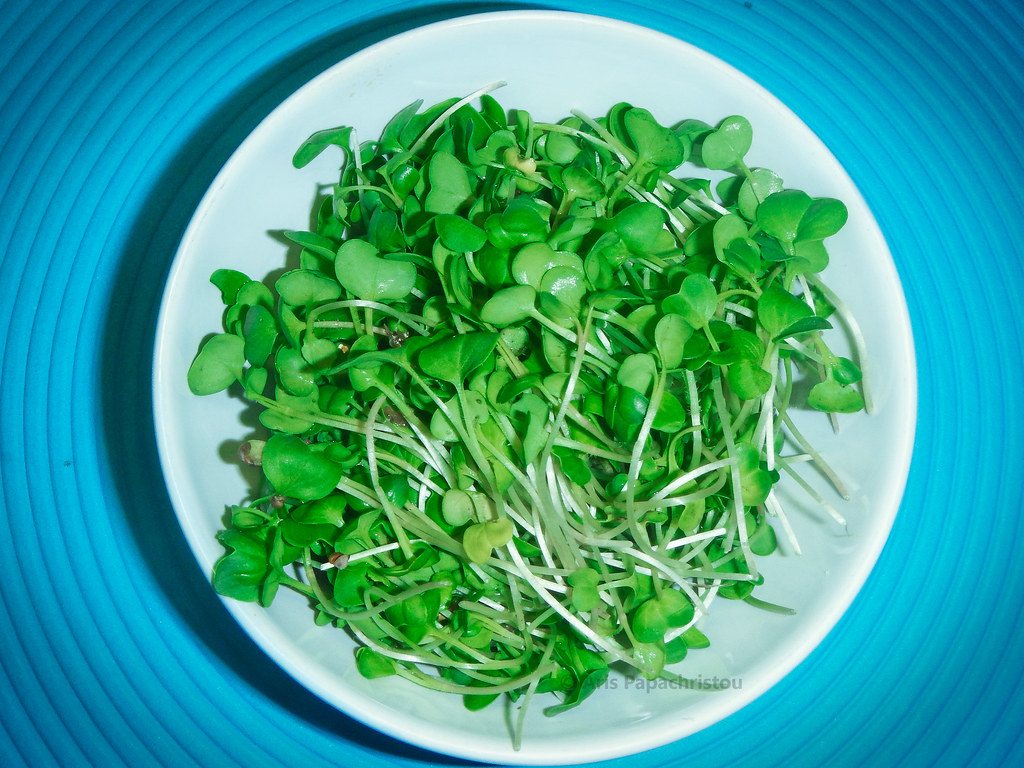
Why do radish microgreens taste spicy? Learn how glucosinolates, myrosinase, and isothiocyanates create their peppery bite—and why flavor varies.
8 min read
What Are Radish Microgreens?
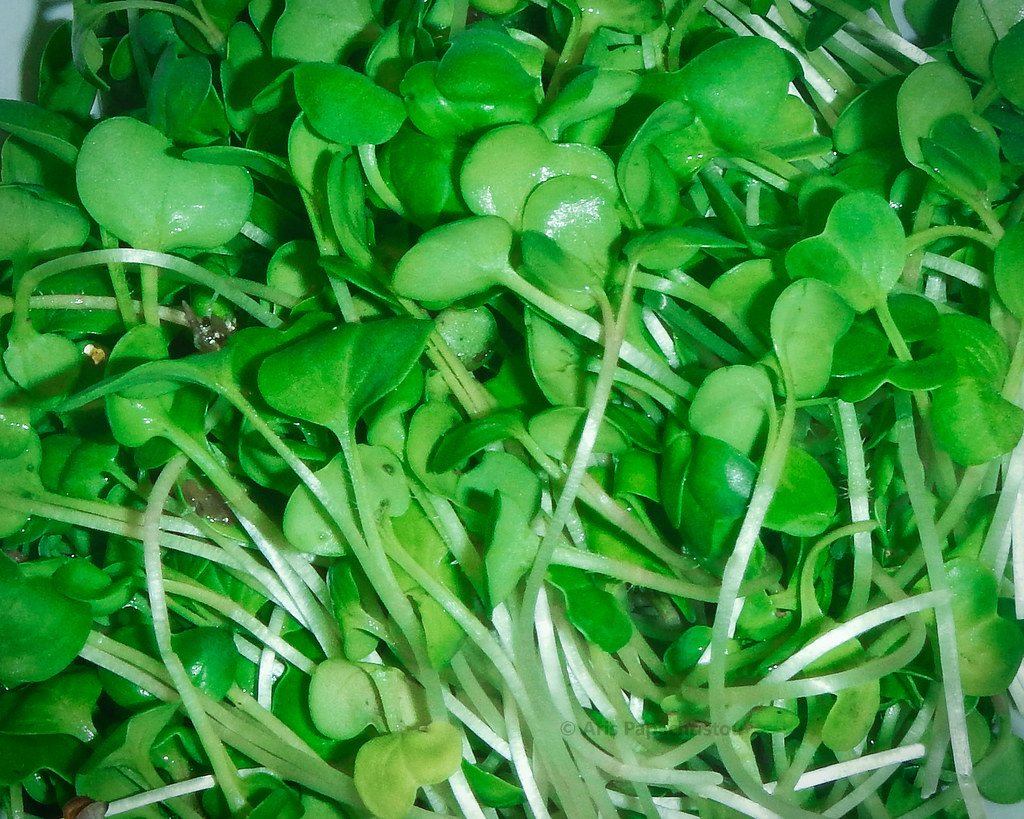
Radish microgreens are young radish seedlings with a crisp, peppery flavor. Learn how they differ from sprouts, how to use them, and the basics of growing them.
10 min read
Sunflower Sprouts vs. Sunflower Microgreens: What’s the Difference?
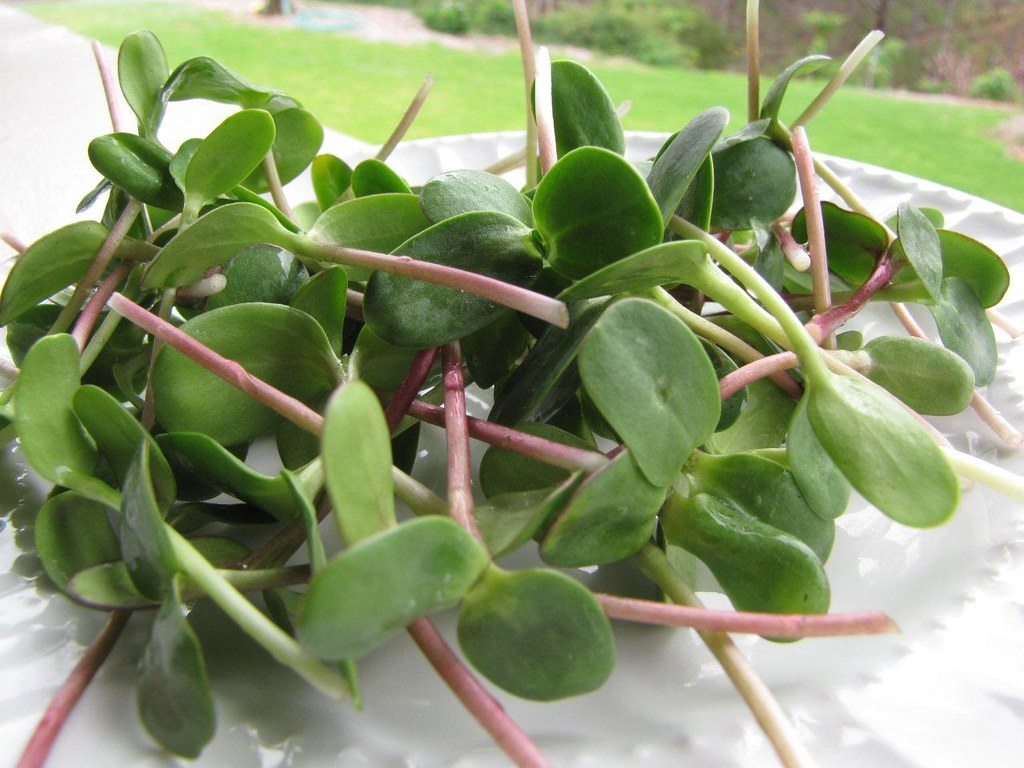
Learn how sunflower sprouts and sunflower microgreens differ in growth stage, harvest method, texture, uses, and raw-food safety considerations.
13 min read
Stay in the loop
New guides, when they publish
An occasional email when a new guide goes live. No spam.
Your email is stored privately for future guide updates. No emails are being sent yet. Privacy policy