Growing & Seeds · Troubleshooting
Microgreen Mold vs. Root Hairs: How to Tell the Difference
Fine, bright-white fuzz that stays closely attached to individual microgreen roots is often normal root-hair growth. Fuzz is more concerning when it forms irregular, web-like patches on the growing medium, seed hulls, stems, or leaves; visibly bridges between plants; spreads outward; or appears alongside weak, soft, collapsed, or dying seedlings.
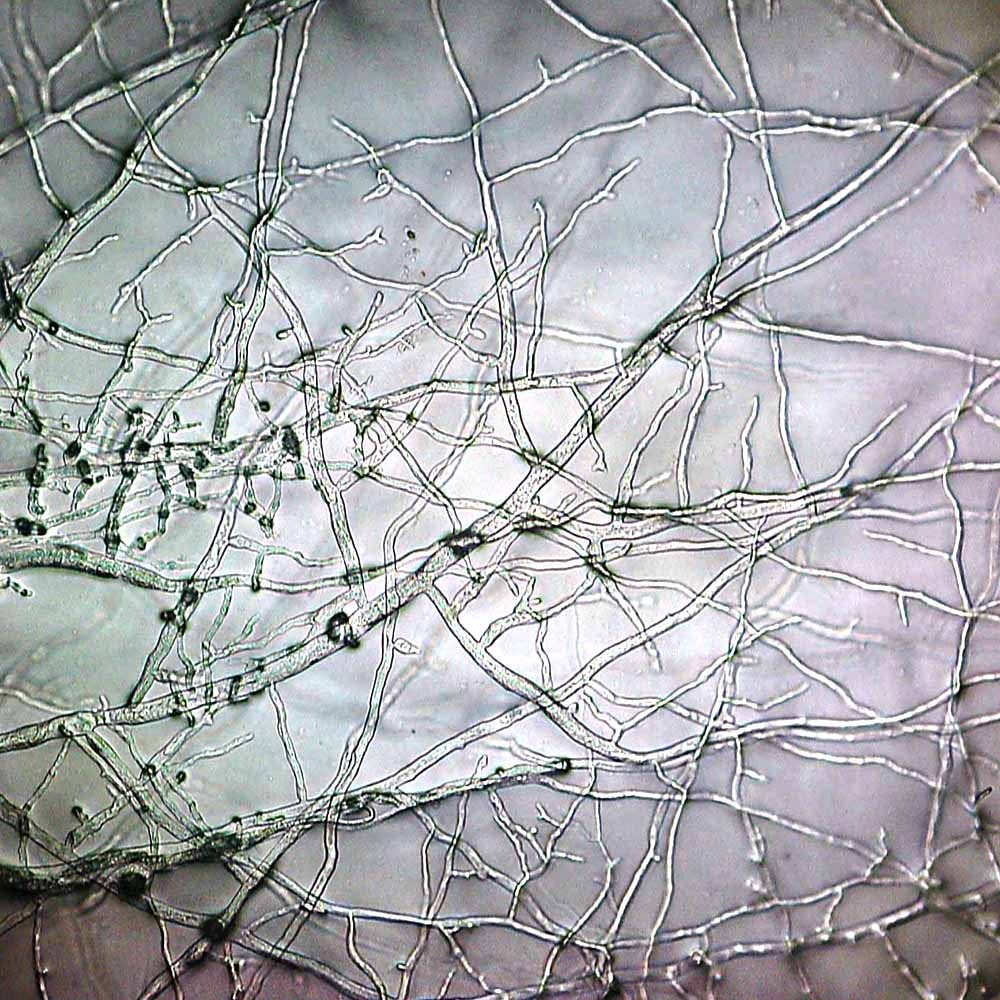
No single clue—including color or a misting test—can confirm what you are seeing or prove a tray is safe to eat. If visible fungal growth is reasonably suspected on raw microgreens, or you cannot confidently tell the difference, the conservative choice is to discard the tray rather than taste-test, trim, or rinse it.
Quick Diagnosis: Root Hairs or Likely Fungal Growth?
More consistent with root hairs
The white fuzz is more likely to be normal root hairs when it:
- Is fine, delicate, and closely follows individual roots.
- Appears relatively even around otherwise healthy seedlings.
- Is concentrated in the root zone rather than spreading across open growing medium.
- Occurs while seedlings remain upright, firm, and actively growing.
- Looks similar around the roots of many healthy seedlings.
Root hairs can be visible on many seedlings in the same tray. The important distinction is whether the fuzz remains attached to each plant’s roots or forms webbing across the medium and between plants.
More concerning for possible fungal growth or seedling disease
Use more caution when you see:
- Patchy, irregular, or web-like growth on the growing medium.
- Fuzz on ungerminated seeds, seed hulls, stems, or leaves.
- Threads of growth visibly bridging between seedlings or crossing open areas of the tray.
- A localized patch that expands over time.
- Seedlings that are water-soaked, pinched near the base, soft, slimy, collapsed, or dying.
- Gray, green, black, mixed-color, or otherwise discolored growth.
These signs do not identify a specific organism from sight alone, but they are not typical features of healthy root hairs.
If you cannot tell
Do not taste-test questionable microgreens. Do not assume rinsing makes them safe. For raw, tender microgreens, discard the tray when fungal growth is reasonably suspected or the visual diagnosis remains uncertain.
What Are Root Hairs?
Root hairs are normal, delicate extensions of root epidermal cells. They increase a plant root’s surface area for taking up water and minerals. Because they are extremely fine and may be densely packed, root hairs can resemble white down or a pale halo around newly germinated microgreen roots. Oregon State University Extension
Where root hairs usually appear
Root hairs develop in a zone behind the actively growing root tip. In a microgreen tray, they are generally:
- Attached directly to the root surface.
- Aligned with the path of individual roots.
- Concentrated below the stem, near or within the growing medium.
- Similar in appearance across healthy seedlings growing under the same conditions.
Their visibility can vary with crop type, growth stage, moisture, lighting, and the growing medium. A tray may show more noticeable root hairs on one day than the next without indicating disease.
Microgreen Mold vs. Root Hairs: Side-by-Side Comparison
| Check | More Consistent With Root Hairs | More Concerning for Possible Fungal Growth or Disease |
|---|---|---|
| Where it appears | Attached closely to individual roots | On growing medium, seed hulls, stems, leaves, or in open spaces between plants |
| Pattern | Fine, even, root-following fuzz | Patchy, web-like, irregular, or visibly bridging between seedlings |
| Seedling condition | Seedlings are upright and developing normally | Seedlings are pinched, soft, water-soaked, collapsed, slimy, or dying |
| Color | Often bright white | May be white, gray, green, black, or mixed; color alone is not decisive |
| Spread over time | Similar root-attached appearance around healthy seedlings | Expands outward from a localized patch or spreads through the tray |
| Food-safety meaning | Does not establish overall food safety | Treat suspected fungal growth conservatively; do not taste-test or rely on rinsing |
Important: These are practical visual clues, not a laboratory identification method. A home photo or visual inspection cannot reliably confirm a fungal species or establish that a tray is free of invisible microbial contamination.
Four Checks That Matter More Than Color Alone
1. Check where the fuzz begins
Location is often more informative than color.
Fine growth consistently attached to roots is more consistent with normal root hairs. Growth that begins on the growing medium, sits around ungerminated seeds, covers seed hulls, or appears on stems or leaves deserves more caution. Practical microgreen-growing guidance similarly distinguishes root-attached hairs from spidery growth on the medium or seeds. Idaho State University
White color alone does not settle the question. Mold can be white, so white fuzz should not automatically be treated as harmless. USDA Food Safety and Inspection Service
2. Check whether it bridges between seeds or plants
Root hairs normally remain associated with each seedling’s roots. They do not usually form obvious threads stretching across open growing medium to connect separate clusters of seedlings.
A patch that looks web-like, irregular, or physically connected between seeds and plants is more concerning for possible fungal growth. That pattern does not prove the presence of a particular mold or pathogen, but it is a reason not to assume the tray is normal.
3. Check the condition of the seedlings
Healthy root hairs do not cause seedlings to collapse.
Watch for signs associated with damping-off or another seedling disease problem, including:
- Stems that look constricted or pinched near the growing-medium line.
- Water-soaked tissue.
- Seedlings that fall over after initially appearing healthy.
- Soft, slimy, or decaying stems and roots.
- Localized patches of dead or declining seedlings.
- Decline spreading through one section of the tray.
Damping-off is a seedling disease problem, not a normal form of root-hair growth. Warm, humid, and persistently wet conditions can favor damping-off and related seedling problems. Penn State Extension Virginia Cooperative Extension
4. Check whether the pattern is spreading
A uniform, root-attached fuzz around vigorous seedlings is generally less concerning than a patch that begins in one area and expands through the tray.
Pay attention to whether growth is:
- Moving beyond roots and onto the medium or foliage.
- Expanding outward from one localized area.
- Becoming denser, patchier, or more web-like.
- Appearing alongside an increasing number of collapsed seedlings.
Avoid relying on a strict time limit. Microgreens grow quickly, and changes in moisture, temperature, and airflow can affect how both root hairs and possible fungal growth appear.
Can Misting Tell You Whether It Is Mold or Root Hairs?
You may encounter advice that misting makes root hairs less visible and therefore proves the fuzz is harmless. Treat this as an informal grower observation—not a validated diagnosis or food-safety test.
A change in appearance after misting does not prove the growth is root hair. It also does not prove the tray is safe to eat.
If a tray looks questionable, assess the full pattern instead:
- Is the fuzz attached directly to individual roots?
- Does it bridge between plants or cross open growing medium?
- Are the seedlings vigorous or declining?
- Is the growth spreading?
- Can you reasonably rule out fungal growth?
If not, use conservative discard guidance.
When Should You Discard a Microgreen Tray?
For raw, high-moisture microgreens, take a cautious approach. Discard the tray rather than trimming, rinsing, or taste-testing it when you see:
- Web-like or patchy growth on the medium, seed hulls, stems, or leaves.
- Fuzz visibly bridging between plants or spreading outward through the tray.
- Gray, green, black, mixed-color, or otherwise discolored fuzzy growth.
- Seedlings that are collapsed, pinched, water-soaked, slimy, soft, or dying.
- An obvious sour, musty, or otherwise off odor noticed during ordinary handling.
- Persistent uncertainty about whether the growth is root hairs or likely fungal growth.
USDA notes that visible mold can be only part of the growth and that moldy food may also contain invisible bacteria. FDA advises that the safest practice is to discard food that looks or smells suspicious. These sources are not specific to home microgreen trays, so discarding a questionable tray is a conservative food-safety recommendation for tender produce intended to be eaten raw. USDA Food Safety and Inspection Service U.S. Food and Drug Administration
What not to do with a questionable tray
- Do not taste-test suspected mold.
- Do not assume cutting above the affected area solves the problem.
- Do not assume rinsing removes visible mold or makes microgreens safe.
- Do not intentionally smell the tray closely to identify the problem.
- Do not rely on household remedies to “rescue” the crop for eating.
After disposal, clean reusable trays, tools, and the surrounding growing area before beginning another batch.
Root Hairs Do Not Confirm Food Safety
Microgreens are different from sprouts
Microgreens and sprouts are different products. Microgreens are generally grown longer, typically in soil or another growing medium, and harvested above that medium. Sprouts are usually harvested earlier in development. U.S. Food and Drug Administration
That distinction matters, but it does not mean microgreens are automatically risk-free. Both are raw produce and benefit from careful growing, handling, storage, and preparation.
A normal-looking tray can still have invisible contamination
This root-hair-versus-mold comparison addresses visible fuzzy growth only. A normal-looking tray is not automatically free of invisible microbial contamination.
Food-safety research identifies several potential contamination routes in microgreen production, including:
- Seeds.
- Water or nutrient solutions.
- Growing materials.
- Trays and equipment.
- Hands and harvest handling.
This does not mean every homegrown tray is contaminated. It means appearance alone cannot verify overall microbiological safety. Turner, Luo, and Buchanan Riggio et al.
How to Reduce Fungal Problems in the Next Tray
Good growing practices can reduce avoidable opportunities for fungal and microbial problems, although they cannot guarantee a mold-free or pathogen-free crop.
- Start with clean trays, tools, hands, water, and growing materials. Virginia Cooperative Extension
- Keep the growing medium moist rather than saturated. Excess water can contribute to root rots and damping-off. Iowa State University Extension and Outreach
- Use a crop-appropriate seeding density rather than overcrowding trays. Virginia Cooperative Extension
- Where your setup permits, use watering practices that avoid repeatedly wetting foliage. Bottom watering can help keep leaves and stems drier. Iowa State University Extension and Outreach
- Maintain reasonable ventilation and avoid persistently stagnant, humid conditions. Virginia Cooperative Extension
- Remove questionable trays rather than trying to grow around a spreading problem. Virginia Cooperative Extension
For a fresh start, use clean materials and adjust one growing variable at a time—such as watering practice, seeding density, or airflow—so you can better identify what improves results in your setup.
Growing supplies
Ready to Start a Fresh Microgreen Tray?
If you choose to discard a questionable tray, begin again with clean growing materials and seeds suited to home microgreen growing. Explore Andi’s Way’s microgreen seed collection and growing trays for your next batch.
Andi’s Way product links are provided as commercial resources, not as food-safety or scientific evidence.
Research & Further Reading
Plant biology and root hairs
- Oregon State University Extension, Vegetative Plant Parts
- University of California Agriculture and Natural Resources, Take a Closer Look at Roots
- University of Wisconsin–Madison Division of Extension, Essentials of Green Growing Plants
Microgreen growing and disease guidance
- Purdue Extension, Grow Microgreens at Home
- Iowa State University Extension and Outreach, How to Grow Your Own Microgreens
- Penn State Extension, Growing Microgreens
- Virginia Cooperative Extension / Virginia Tech, Introduction to Microgreen Production in Indoor Vertical Farms and Greenhouses
- Idaho State University, The Mighty Microgreen
Food safety and mold-discard guidance
- U.S. Food and Drug Administration, Are You Storing Food Safely?
- U.S. Food and Drug Administration, Guidance for Industry: Standards for the Growing, Harvesting, Packing, and Holding of Sprouts for Human Consumption
- U.S. Food and Drug Administration, Guidance for Industry: Standards for the Growing, Harvesting, Packing, and Holding of Sprouts for Human Consumption (PDF)
- U.S. Department of Agriculture Food Safety and Inspection Service, Molds on Food: Are They Dangerous?
Peer-reviewed microgreen food-safety research
- Turner, E. R., Luo, Y., & Buchanan, R. L., Microgreen nutrition, food safety, and shelf life: A review
- Riggio, G. M., Wang, Q., Kniel, K. E., & Gibson, K. E., Microgreens—A review of food safety considerations along the farm to fork continuum
- Microbial growth and attachment of Salmonella and enterohemorrhagic and enteroaggregative Escherichia coli strains on cress microgreens grown in peat soil system
Andi’s Way product information — not scientific evidence
- Andi’s Way, Organic Microgreen Seeds and Beans
- Andi’s Way, Growing Trays – 10x20 Flats With OR Without Drain Holes
Frequently asked questions
Related guides
Sunflower Microgreen Mold: Root Hairs, Causes, and Prevention
White fuzz on sunflower microgreens may be normal root hairs—or mold. Learn the key differences, sunflower-specific causes, prevention steps, and when to discard a tray.
13 min read
Sunflower Sprouts vs. Sunflower Microgreens: What’s the Difference?
Learn how sunflower sprouts and sunflower microgreens differ in growth stage, harvest method, texture, uses, and raw-food safety considerations.
13 min read
Best Microgreens for Beginners: Radish, Broccoli, Pea, or Sunflower?
Compare radish, broccoli, pea, and sunflower microgreens by seed prep, harvest time, flavor, and beginner-friendliness to choose your first tray.
10 min read
Stay in the loop
New guides, when they publish
An occasional email when a new guide goes live. No spam.
Your email is stored privately for future guide updates. No emails are being sent yet. Privacy policy