Growing & Seeds · Growing
Microgreen Seed Density: How Much Seed per 10×20 Tray?
There is no one seed weight that fits every microgreen crop in a 10×20 tray. A 10×20 greenhouse flat is commonly called a 1020 tray, but the usable interior planting area can vary by tray design. Start with a crop-specific benchmark, then refine it for your actual tray area, seed lot, growing medium, watering, light, and airflow conditions. Penn State Extension Virginia Cooperative Extension
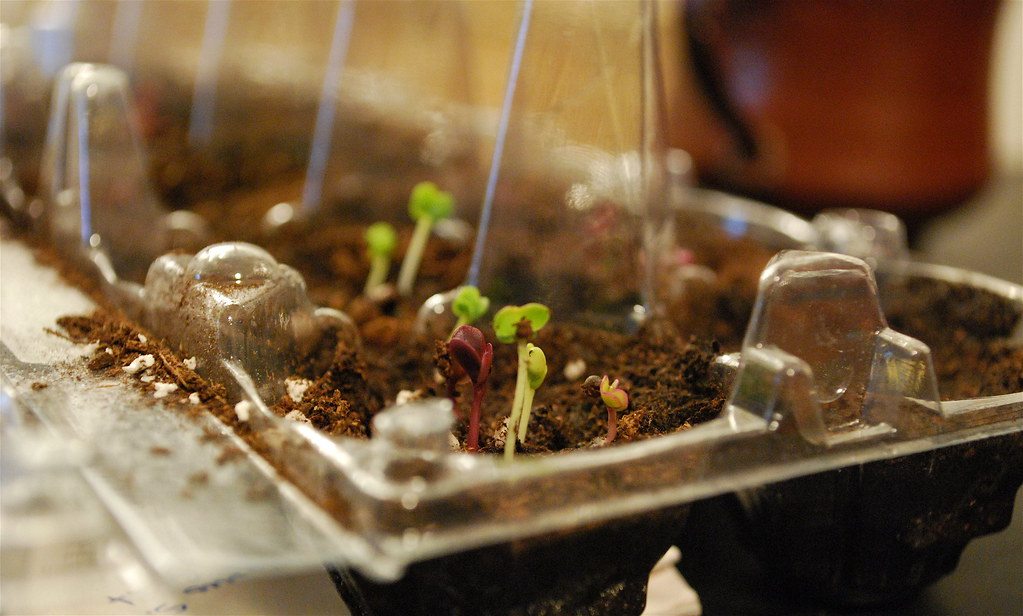
The table below lists general 1020-tray seeding guidelines from Utah State University Extension. These are useful starting points—not universal or “perfect” rates.
| Crop | General starting rate per nominal 1020 tray |
|---|---|
| Broccoli | 28 g |
| Radish | 42 g |
| Pea | 150 g |
| Sunflower | 48 g |
| Arugula | 10 g |
Source note: Utah State University Extension lists these as general seeding guidelines for a 1020 tray. Measure your actual planted area, use a scale, and test modest adjustments in your own setup. Utah State University Extension
What Does Microgreen Seed Density Mean?
Strictly speaking, seed density is the number of seeds planted within a defined growing area. Commercial growers and researchers may express it as seeds per square inch or square centimeter. Home growers often track it as grams of seed per tray because weighing seed is practical and repeatable. Virginia Cooperative Extension
Grams are useful, but they are not a universal measure of plant density. Equal seed weights can contain very different numbers of seeds.
For example, University of Maryland Extension lists approximately:
- 53 beet seeds per gram
- 281 broccoli seeds per gram
- 530 mustard seeds per gram
In other words, one gram of mustard seed can produce a much denser stand than one gram of beet seed. Even crops with similarly sized seeds can need different rates because their germination, stem size, growth habit, and harvest stage differ. University of Maryland Extension
Why Pea Shoots Need More Grams Than Broccoli Microgreens
Pea seed is much larger and heavier than broccoli seed. That helps explain why Utah State University Extension lists a general starting rate of 150 grams for pea and 28 grams for broccoli in a 1020 tray. Utah State University Extension
This does not mean peas should be packed more tightly than broccoli. It means that comparing crops by seed weight alone can be misleading. The goal is crop-appropriate coverage that allows reasonably uniform growth and manageable moisture conditions.
Why There Is No Universal Microgreen Seeding Rate
A published tray rate is a helpful baseline, but it cannot account for every seed lot, tray, medium, or growing environment. Virginia Cooperative Extension recommends that growers test density for their own facility, production system, substrate, species, and cultivar. Virginia Cooperative Extension
Crop and Seed Size Matter
Seed size is one reason seeding rates differ. Large seeds require more weight to provide a given level of coverage, while very small seeds can create an overly dense stand at relatively low weights.
However, seed size is not the only consideration. Broccoli and radish are both commonly grown as small-seeded microgreens, yet Utah State University Extension lists 28 grams for broccoli and 42 grams for radish. Related crops should not automatically receive the same rate. Utah State University Extension
Cultivar, Seed Lot, and Germination Matter
Seed lots and cultivars of the same crop can differ in seed size, germination performance, and growth habit. Virginia Cooperative Extension
If germination is poor, do not automatically respond by adding more seed next time. Check other possible causes first, including seed quality, moisture, temperature, sowing uniformity, and the condition of the growing medium. Penn State’s density guidance treats germinability and seed weight as factors in calculating a crop’s seed requirement. Penn State Extension
Tray Area and Growing Conditions Matter
The same seed weight can produce different results when any of these variables change:
- Usable interior tray area
- Growing medium or hydroponic system
- Light conditions
- Watering practices
- Temperature
- Air circulation
- Harvest stage
- Seed lot or cultivar
A rate that gives good coverage in one indoor rack or greenhouse may be too sparse or too crowded in another. That is why a documented baseline and controlled trials are more useful than searching for one permanent “correct” number.
How to Scale a 1020 Seed Rate for Any Tray Size
Published rates are tied to a tray format or growing area. To adapt a rate responsibly, scale it using the actual planted surface area, rather than relying only on the outside dimensions printed on the tray. Penn State Extension
Measure the Planted Surface, Not Just the Tray Label
A tray labeled 10×20 inches may have wide rims, tapered sides, rounded corners, or an interior base smaller than its nominal outside dimensions. Measure the area where seed will actually be spread.
Use this calculation:
``text Planted area = interior length × interior width ``
Use the same measurement method for your tray and for the reference tray whenever possible.
Use This Seed-Rate Formula
``text Seed amount for your tray = reference seed amount × (your planted area ÷ reference planted area) ``
For example, a nominal 10×10 tray has about half the nominal area of a 10×20 tray: 100 square inches compared with 200 square inches. It may therefore use roughly half the seed amount as an initial estimate. Still, measure the interior growing area before treating that estimate as exact.
The formula scales a published benchmark. It does not remove the need to observe the crop and refine the rate for your conditions.
Why a Scale Is Better Than Tablespoons
Use a kitchen scale that measures grams whenever possible. Volume measures such as tablespoons are less reliable because seeds vary substantially in size, shape, and weight.
A tablespoon of pea seed does not weigh the same as a tablespoon of broccoli or radish seed. Weighing seed makes it easier to repeat successful sowing rates and compare trials accurately. University of Maryland Extension
How to Tell if Your Microgreen Seed Density Is Too High or Too Low
Density is only one possible cause of uneven or disappointing growth. Watering, light, temperature, seed quality, sowing technique, and media can create similar symptoms. Still, these observations can help you decide whether a density trial is worthwhile.
Possible Signs the Tray Is Too Crowded
A tray may be too densely seeded for your system if you notice:
- Uneven canopy development
- Tightly packed stems that are difficult to separate
- Elongated or competing growth
- A persistently damp canopy or tray base
- Limited air movement through the stand
- Difficult harvest handling or reduced visual uniformity
In a greenhouse study of mungbean, lentil, and Indian mustard microgreens, higher tested densities reduced marketable quality and increased competition-related problems in some treatments. That does not mean every dense tray will perform poorly, but it supports testing density rather than assuming more seed is always better. PLOS ONE study
Possible Signs the Tray Is Too Sparse
A tray may be too lightly seeded for your harvest goal if it has:
- Open areas across the planted surface
- Sparse or uneven coverage after germination
- Large gaps between plants
- Low use of the available growing area
- A harvest that does not provide the coverage or output you expected
Sparse coverage does not prove that the seed rate was too low. Uneven sowing and poor germination can create similar results. Treat these as troubleshooting clues, not a diagnosis. Horticulturae study
Does More Seed Always Produce More Microgreens?
No. Controlled studies indicate that density responses vary by crop. Total fresh biomass may rise as density increases up to a crop-specific point, then level off or decline. Increasing density can also affect canopy coverage, stem form, uniformity, and marketable quality. Plants study Horticulturae study
The best rate depends on what you are trying to optimize. A grower may prioritize:
- Even coverage
- Stem length and appearance
- Uniformity
- Ease of harvest
- Fresh weight
- Yield relative to seed used
- Moisture management
- Repeatability from tray to tray
The rate that produces the highest harvest weight is not necessarily the rate that produces the best-looking, easiest-to-harvest crop.
Density, Moisture, and Airflow
A crowded microgreen stand may retain more moisture and be harder to keep well ventilated. University of Maryland Extension recommends good air circulation and avoiding saturated media or trapped excess moisture around microgreens. University of Maryland Extension
This is a management concern, not a universal food-safety cutoff. There is no single gram amount that makes a tray inherently “safe” or “unsafe.” Food safety also depends on seed handling, sanitation, water quality, temperature, moisture management, harvesting, and postharvest handling. Virginia Cooperative Extension
One controlled study found higher microbial counts at higher tested densities for cress, rocket, and pea under its specific growing conditions. It does not establish a universal density limit for home 1020 trays, but it reinforces the value of avoiding persistently wet, poorly ventilated conditions. Plants study
A Simple Method to Dial In Your Seed Rate
The most dependable way to find a useful rate is to start with a documented crop-specific benchmark and make controlled adjustments.
Start With a Crop-Specific Benchmark
For broccoli, radish, pea, sunflower, and arugula, Utah State University Extension’s 1020-tray guidelines provide practical starting references. Utah State University Extension
Before sowing:
- Measure the usable planted area of your tray.
- Weigh the seed in grams.
- Spread the seed as evenly as practical.
- Record the crop, seed lot, tray dimensions, and starting seed weight.
Test Small Changes, One Variable at a Time
To compare density, change the seed amount while keeping other conditions as consistent as practical.
Try to hold these variables steady:
- Seed lot
- Tray type and planted area
- Growing medium
- Watering approach
- Light setup
- Temperature
- Harvest stage
If you change density, lighting, watering, and medium all at once, it becomes difficult to tell which change affected the result.
Record the Results That Matter
A simple trial log can help you build a repeatable system.
| Trial detail | What to note |
|---|---|
| Crop and seed lot | Species, cultivar if known, and identifying lot information |
| Tray area | Actual interior planted length and width |
| Seed weight | Grams planted |
| Germination and coverage | Evenness, open spaces, and visible density |
| Crop appearance | Uniformity, stem form, and overall quality |
| Moisture and airflow | Whether the canopy stayed overly wet or difficult to ventilate |
| Harvest handling | Ease of cutting and collecting the crop |
| Harvest weight | Optional, if fresh yield is one of your goals |
Choose a Rate for Your Goal
After a few comparable trials, choose a rate that works reliably in your conditions. The goal is not necessarily the heaviest possible tray. A practical rate may be one that balances coverage, quality, moisture management, uniformity, and ease of harvest.
Why “10–15 Grams per Tray” Is Not a Universal Rule
You may see broad guidance recommending about 10 to 15 grams of seed per 10×20 flat. University of Maryland Extension gives that amount as a general home-growing example, while also noting that the seed size affects how many seeds fit within the tray. University of Maryland Extension
That type of broad guidance can be useful, but it is not a complete crop-by-crop density chart.
Utah State University Extension’s crop-specific guidance ranges from 10 grams for arugula to 150 grams for pea in a 1020 tray. That wide range shows why a general 10–15 gram rule cannot be applied to every microgreen. Utah State University Extension
Use broad guidance as context. For actual sowing decisions, start with a crop-specific benchmark and refine it through measured trials in your own setup.
Research & Further Reading
University and Extension Guidance
Utah State University Extension, Grow Your Own Microgreens https://extension.usu.edu/yardandgarden/research/grow-your-own-microgreens
University of Maryland Extension, Growing Microgreens and Baby Greens Indoors https://extension.umd.edu/resource/growing-microgreens-and-baby-greens-indoors
Virginia Cooperative Extension / Virginia Tech, Introduction to Microgreen Production in Indoor Vertical Farms and Greenhouses https://www.pubs.ext.vt.edu/SPES/spes-756.html
Penn State Extension, Growing Microgreens https://extension.psu.edu/growing-microgreens
Penn State Extension, The ABCs of Microgreens https://extension.psu.edu/the-abcs-of-microgreens
Peer-Reviewed Research
Microgreens: Optimising Seed Density and Exploring the Influence of White Light and White Light Supplemented with UV-A Radiation https://pmc.ncbi.nlm.nih.gov/articles/PMC12944421/
Yield Optimization, Microbial Load Analysis, and Sensory Evaluation of Mungbean, Lentil, and Indian Mustard Microgreens Grown Under Greenhouse Conditions https://pmc.ncbi.nlm.nih.gov/articles/PMC9128967/
Optimising Sowing Density for Microgreens Production in Rapini, Kale and Cress https://www.mdpi.com/2311-7524/10/3/274
Trial Protocol for Evaluating Platforms for Growing Microgreens in Hydroponic Conditions https://pmc.ncbi.nlm.nih.gov/articles/PMC9103178/
Company and Product Information — Not Scientific Evidence
Andi’s Way, Organic Sprouting Seeds https://andisway.com/collections/organic-sprouting-seeds
Andi’s Way, Growing Trays – 10×20 Flats With or Without Drain Holes https://andisway.com/products/growing-trays-with-drain-holes
Frequently asked questions
Related guides
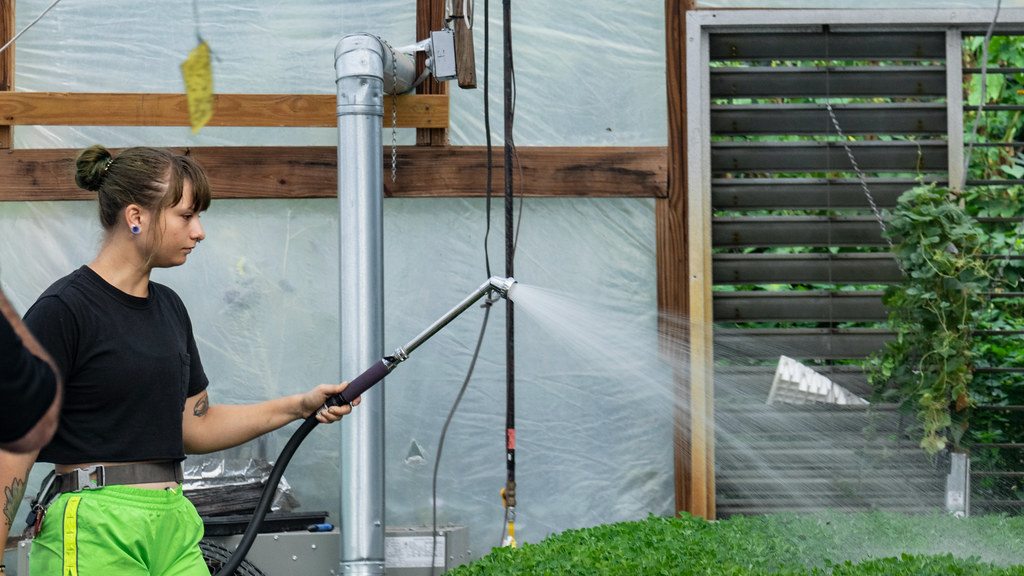
How to Bottom-Water Microgreens Without Waterlogging the Tray
Learn how to bottom-water microgreens with nested trays, moisture checks, drain-off steps, and practical tips to avoid soggy media and standing water.
12 min read
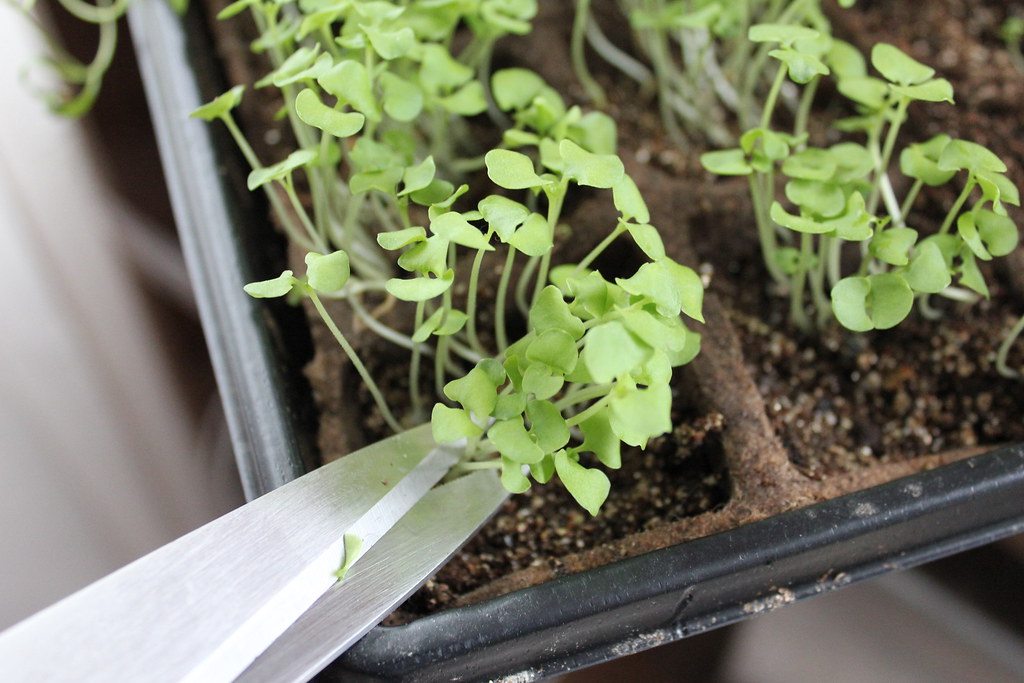
Best Growing Medium for Microgreens: Soil vs Coco Coir vs Grow Mats
Compare potting mix, coco coir, and grow mats for microgreens. Learn the trade-offs in watering, cleanup, crop support, reuse, tray setup, and food safety.
16 min read
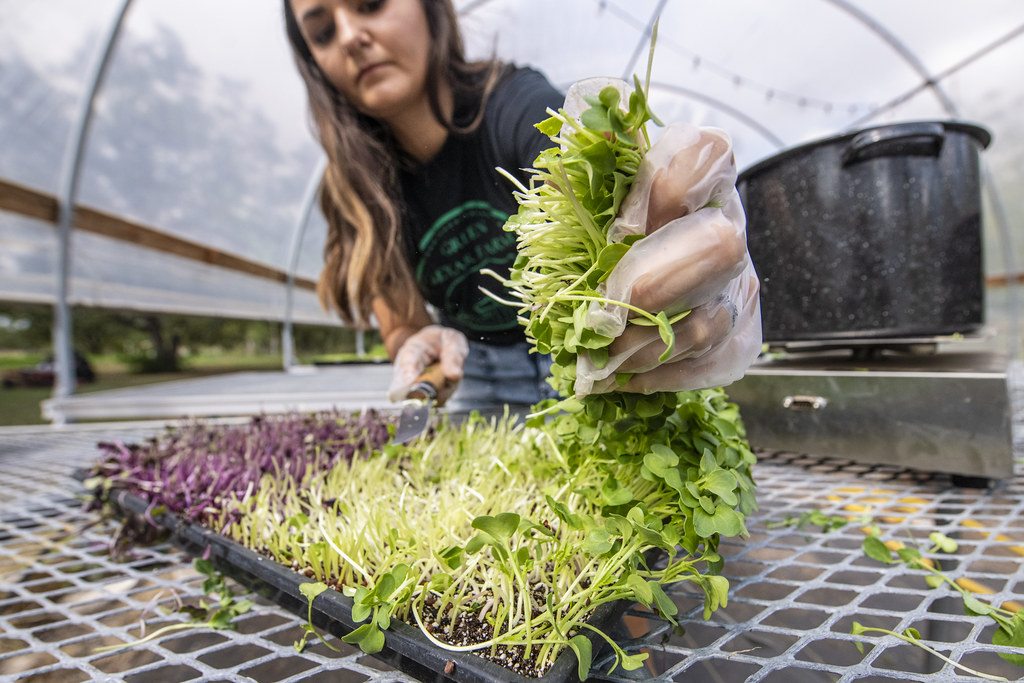
Do Microgreens Regrow After Cutting?
Most microgreens are a one-time harvest. Learn why some shoots may regrow after cutting, how baby greens differ, and when reseeding is the better choice.
8 min read
Stay in the loop
New guides, when they publish
An occasional email when a new guide goes live. No spam.
Your email is stored privately for future guide updates. No emails are being sent yet. Privacy policy